There are many different names for the over-the-counter (OTC) medications that people take to relieve joint pain. Some reduce inflammation, some reduce pain. Some are taken in pill or tablet form. Others are used topically (on the skin). The choices can be overwhelming. Cut through the confusion with this doctor-reviewed guide to making safe choices when you're looking for OTC pain relievers.
Oral NSAIDs (The Anti-Inflammatories)
Non-steroidal anti-inflammatory drugs (NSAIDs) are medicines for bringing down inflammation that causes pain, swelling, redness, and fever. But they do not contain corticosteroids, like cortisone or prednisone, which are strong anti-inflammatories. If your arthritis is severe, your doctor may prescribe corticosteroids or prescription-strength NSAIDs, including COX-2 inhibitors like celecoxib (Celebrex).
Osteoarthritis (OA) happens when the cartilage lining and cushioning joints breaks down. Rheumatoid arthritis (RA) occurs when the lining of joints swell. Both types of arthritis (and many other related types) cause pain, stiffness, and tenderness. For mild or moderate pain caused by osteoarthritis, rheumatoid arthritis, or overdoing it on weekends, OTC NSAIDs may suffice. Along with joint and muscle pain, OTC anti-inflammatory medicines treat acute pain, such as:
- Back pain
- Dental pain
- Headaches, including migraine
- Menstrual cramps
- Mild pain after surgery
- Musculoskeletal injuries, like sprains, strains, tendonitis, bursitis
- Neck pain
- Pain from kidney stones
And since NSAIDs can be as effective as opioids in some cases, they help avoid the use of opioids, which can become addictive. The CDC recommends that health care providers use nonopioid treatments, such as OTC NSAIDs, for acute pain whenever possible.
OTC NSAIDs include aspirin, ibuprofen (Advil, Motrin), and naproxen (Aleve).
Aspirin
Aspirin (acetylsalicylic acid) relieves mild pain and fever. It’s available orally under many brand names, including Bayer, Bufferin, Ecotrin, and St. Joseph. Aspirin is known to thin the blood.
Low-dose aspirin therapy has been used for some people younger than 60 who have a significant risk of cardiovascular disease to prevent blood clots and decrease the risk of stroke or heart attack. If your doctor has recommended low-dose aspirin therapy for you, talk to your doctor about what to use for mild-to-moderate pain. Taking ibuprofen or naproxen along with aspirin could thin your blood too much and cause bleeding in your gastrointestinal (GI) tract.
Side effects of aspirin
The most common side effects of aspirin are stomach pain, heartburn, nausea, and vomiting. Stomach irritation can lead to ulcers and bleeding in the stomach.
You can reduce the risk of stomach problems by taking aspirin with food or milk.
Other risks of aspirin include:
- Allergic reactions (hives, facial swelling, wheezing, and asthma)
- Excessive bleeding and bruising
- Ringing in the ears and slight deafness
If you have any of these effects, stop taking the medication and call your doctor.
When should you avoid aspirin?
Don’t take aspirin if you know you are allergic to it. Avoid taking aspirin if you:
- Have stomach ulcers
- Have bleeding problems
- Are scheduled for surgery
Talk to your doctor before using aspirin if you:
- Have kidney disease
- Have liver disease
- Drink more than three alcoholic drinks per day
Ibuprofen
Ibuprofen (Advil, Motrin) is a short-acting NSAID. That means it works quickly and leaves your body in a few hours. Ibuprofen relieves the pain, swelling, and stiffness of OA, RA, gout, ankylosing spondylitis, and psoriatic arthritis. It’s also used to treat mild problems like headache, toothache, and menstrual cramps. You might consider taking ibuprofen if your pain is mild and you want it to ease up for a few hours. For example, if you’re going to bed soon and easing your mild pain will help you sleep better, ibuprofen may be helpful.
Ibuprofen is available in many generic and store-brand products, and it may be the active ingredient in products labeled "non-aspirin pain relief."
Side effects of ibuprofen
While taking ibuprofen, you may feel nauseous or have diarrhea. Taking it with food or milk helps to prevent nausea. You may also notice symptoms like:
- Bloating or gas
- Constipation
- Dizziness
- Nervousness
- Ringing in your ears
When to avoid ibuprofen
Use of NSAIDs can increase the risk of heart attack or stroke, particularly in higher doses. You should not use ibuprofen for pain if you are allergic to aspirin or other NSAIDs. Avoid taking ibuprofen if you have:
- Asthma
- Heart disease
- High blood pressure
- Kidney disease
- Liver cirrhosis
- History of stomach problems
Talk to your doctor before taking ibuprofen if you:
- Take blood thinners
- Take a diuretic
- Are pregnant (especially if you are in the third trimester of pregnancy)
- Are breastfeeding
Naproxen
Naproxen (Aleve, Anaprox, Naprelan, Naprosyn) is a long-acting NSAID. Like aspirin and ibuprofen, naproxen also helps to ease mild-to-moderate pain and swelling caused by arthritis and other conditions. Its effects last from eight to 12 hours, so you take it only once or twice a day. When taking naproxen for arthritis, it may take two weeks or longer to feel a difference.
Side effects of naproxen
While taking naproxen, you may feel nauseous or have diarrhea. Taking it with food or milk helps to prevent nausea. You may also notice symptoms like:
- Dizziness
- Drowsiness
- Burning or tingling in arms or legs
- Heartburn
- Indigestion
- Lightheadedness
- Headache
- Stomach cramps
When to avoid naproxen
NSAIDs can increase the risk of heart attack or stroke, particularly in higher doses. NSAIDs like naproxen may also cause ulcers or bleeding anywhere along the digestive tract (esophagus, stomach, intestines). The risk of bleeding or ulcers is higher if you take NSAIDs at high doses or for long periods of time. The risk is also higher in those who smoke, drink more than the recommended amount of alcohol, or are older than 65.
You should not use naproxen for pain if you are allergic to aspirin or other NSAIDs. Avoid taking naproxen if you have:
- Asthma
- Heart disease
- High blood pressure
- Kidney disease
- Liver cirrhosis
- History of stomach problems
- A scheduled surgery
- A pregnancy (especially at 20 weeks or later)
Talk to your doctor before taking ibuprofen if you:
- Take blood thinners
- Take a diuretic
- Are pregnant
- Are breastfeeding
Acetaminophen (The Pain Blocker)
Unlike aspirin, ibuprofen, and naproxen, acetaminophen (Tylenol) is not an NSAID. That means it doesn't reduce inflammation. But acetaminophen does relieve pain and fever by blocking pain receptors in the body and targeting the part of the brain that regulates heat.
Acetaminophen is an ingredient in more than 600 OTC products aimed at easing pain from headache, menstrual cramps, sore back, toothache, and arthritis.
Acetaminophen is the active ingredient in many products labeled "aspirin-free pain reliever" or "non-aspirin pain reliever." To be sure what you’re getting in a medicine, read the ingredients. Acetaminophen can hide in many sleep aids, such as PM formulas of pain relievers, and sinus medications. Many other products also contain acetaminophen, including some prescription pain relief combination medicines.
Taking several different types of medications without checking the ingredients on the label can lead to accidental liver toxicity.
Acetaminophen side effects
When taken as directed — no more than 3000 mg per day — acetaminophen has few side effects. But taking more than directed, taking it longer than directed, or having alcoholic drinks while using acetaminophen can cause liver damage and even liver failure. Alcohol converts acetaminophen into byproducts that are toxic to the liver.
Certain people may have to take a lower dosage or may not be able to take acetaminophen at all.
Because the symptoms of liver damage from acetaminophen may not be immediately noticeable, if you think you may have taken too much, call 911 or poison control at 800-222-1222 right away.
When to avoid acetaminophen
You should not take acetaminophen if you have three or more alcoholic drinks daily or if you have advanced liver or kidney disease. Sometimes the liver damage caused by taking too much acetaminophen requires a liver transplant.
If you are pregnant, talk to your doctor about the risks or benefits of using acetaminophen. Recently, the FDA warned that taking acetaminophen during pregnancy could be associated with autism or attention deficit hyperactivity disorder (ADHD).
The Problem With Combining OTC Pain Relievers
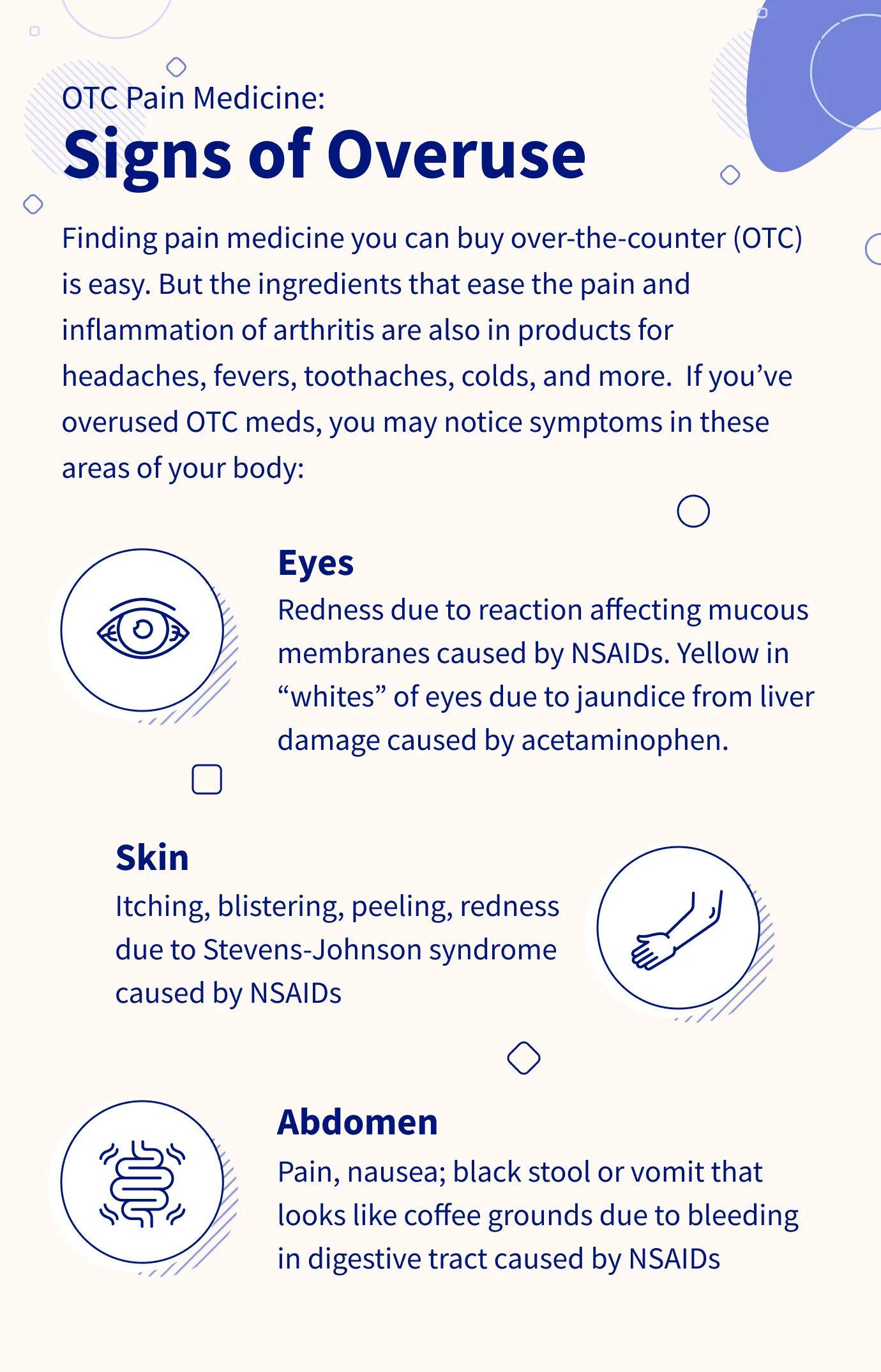
Because many OTC products contain the same ingredients, it's important to know what’s in the medicines you take. Otherwise, if you take more than one product, you may get too much of one ingredient. Overdoses of any of these pain relievers can increase the risk of side effects and even be fatal. An overdose of NSAIDs may cause bleeding in your digestive tract or ulcers in your stomach. An overdose of acetaminophen may damage your liver.
Some OTC products also combine multiple pain reliever ingredients. For example, aspirin or ibuprofen may be combined with acetaminophen in a single tablet, such as Advil Dual Action or Motrin Dual Action. The headache medicine Excedrin contains aspirin, acetaminophen, and caffeine.
Some medicines combine OTC pain relievers with other drugs, such as antihistamines or decongestants, or medicine to help you sleep. There may be times when your doctor says it’s OK to use more than one drug -- such as when you have a cold or the flu. But don't just grab anything off the shelf.
If you're already taking an NSAID like aspirin, ibuprofen, or naproxen to treat your arthritis pain and you get a cold, ask your doctor if taking a cold medicine that contains acetaminophen would be safe for you. That way, you don't get a double dose of an NSAID and vice versa. If you're already taking acetaminophen to treat your arthritis pain and you get a cold, ask your doctor if taking a cold medicine that contains an NSAID would be safe for you.
Targeted Relief: Topical Creams, Gels, and Patches
If taking OTC pain relievers by mouth upsets your stomach or causes other side effects, topical pain relievers — gels, creams, and patches placed directly on your skin — may be a way to ease your pain.
A review of 61 studies shows that topical analgesics relieve pain without the side effects of oral NSAIDs. Ingredients that produced the most pain relief in topical forms were the NSAIDs diclofenac, ibuprofen, indomethacin, ketoprofen, and piroxicam. Topical forms of indomethacin, ketoprofen, and piroxicam (Feldene) are prescription only.
Topical treatments might be an option if you:
- Are older than 65
- Have stomach issues, such as ulcers
- Have heart disease risk factors
- Have arthritis in small joints, such as in your hands, elbows, knees, and feet
- Want to control where you want pain relief
Common topical OTC pain relievers include:
- Diclofenac (Voltaren), which is available in patches, gel, and creams, is the only topical over-the-counter NSAID that is FDA-approved for treating arthritis pain. Some OTC topical products have familiar names, such as Advil, Aleve, or Motrin, but they don't contain ibuprofen or naproxen. Instead, they contain diclofenac.
- Methyl salicylate and trolamine salicylate are derived from aspirin and are in several OTC products, such as Aspercreme, Blue Emu, and Salonpas. If you take blood thinners or have an aspirin allergy, talk to your doctor before using products containing these ingredients.
- Menthol and camphor are common ingredients in many OTC gels, creams, and patches marketed for pain relief, but they are not NSAIDs. Examples include BenGay, Biofreeze, Icy Hot, and Tiger Balm.
- Lidocaine temporarily relieves pain by numbing an area. One example is Tylenol Precise, which does not contain acetaminophen.
- Capsaicin, derived from hot peppers, temporarily relieves pain by blocking pain signals. Although it's not an NSAID, a few studies have shown that capsaicin relieved arthritis pain.
Topical treatments don't have as many side effects as oral NSAIDs because far less of the medicine is absorbed into your blood. But that doesn't mean topicals are completely free of side effects. If your skin is sensitive, a pain patch, gel or cream may irritate your skin and cause redness or a rash. After applying a topical pain reliever, wash your hands (and don't touch your eyes!).
| OTC TREATMENT | CONDITION | EFFECT |
| Acetaminophen (Tylenol) | Osteoarthritis | Eases dull aches, reduces fever; too much could damage liver |
| NSAIDs: aspirin, ibuprofen (Advil, Motrin), naproxen (Aleve) | Rheumatoid arthritis Gout | Reduces inflammation, eases pain Overuse could cause gastrointestinal (GI) bleeding or heart risks |
| Topical: diclofenac (Voltaren) | Arthritis | Lowers pain and inflammation in small joints without GI side effects |
| Topicals: capsaicin, lidocaine | Nerve-related joint pain | Blocks pain signals, numbs area temporarily |
OTC Supplements
If over-the-counter NSAIDs or acetaminophen are not an option for you, there are a few supplements that may help ease your symptoms. Although these supplements are not medications, they often are found in the OTC pain relief aisle. Be cautious with supplements. They are not FDA approved treatments. Supplements also don't have the same strict manufacturing rules as there are with medications.
Supplements that have the strongest evidence for use in people who have arthritis include:
Boswellia. Boswellia comes from resin in the Indian frankincense plant. A study of boswellia, in a preparation called Aflapin, decreased inflammation, improved cartilage, and reduced pain and stiffness. People with OA in the study took 100 milligrams per day for 30 days.
Ginger. This pungent root has shown that it can reduce inflammation in people with RA as well as steroids and in people with OA as well as the NSAIDs ibuprofen and celecoxib. Ginger decreased knee pain after three months of use.
Glucosamine and chondroitin. The combination of glucosamine and chondroitin — both naturally found in cartilage — has been shown to reduce joint inflammation. The combo may also protect cartilage cells. Together they have a low risk of interacting with other medicine you may take for arthritis.
Methylsulfonylmethane (MSM). MSM is found in foods. As a supplement, it has been shown to reduce inflammation. In one study, it improved mild knee pain in those who took 2,000 milligrams per day for 12 weeks.
S-adenosylmethionine (SAM-e). This supplement is made in a laboratory. In nature, it's found in your own body's cells. As a supplement, it might reduce the perception of pain in the brain and decrease inflammation. Some studies have shown that it relieved osteoarthritis symptoms as well as NSAIDs but with fewer side effects.
Turmeric. This bright yellow spice has the active ingredient curcumin, which is known to reduce inflammation. In a review of studies of nearly 2,400 people with five types of arthritis, curcumin showed improvement in arthritis symptoms. Pain, inflammation, and stiffness decreased, as did the number of tender and swollen joints. Dosages varied from 120 milligrams to 1,500 milligrams, and some people took the supplement for as little as four weeks or as long as 36 weeks.
When to See Your Doctor
Just because some pain relievers can be bought without a prescription doesn't mean they're all completely safe. Depending on your personal situation, even OTC pain relievers may be risky for you to take.
If you experience any of the following symptoms after taking an OTC NSAID like aspirin, ibuprofen (Advil, Motrin) or naproxen (Aleve), stop taking the medicine and call your doctor:
- Blood in your poop
- Heartburn
- Poop that looks black and sticky like tar
- Stomach pain
- Vomit that is bloody or looks like coffee grounds
You should also call your doctor if any of these situations occur:
- The symptoms you're trying to relieve with the OTC pain meds get worse
- You develop new or unexpected symptoms
- The part of your body that was painful becomes red or swollen
- Your pain lasts for more than 10 days
- You have a fever that lasts longer than three days
- You've started to feel you have a problem with overusing OTC meds
Takeaways
Finding pain relievers you can buy without a prescription is easy. Figuring out which one might be best for you can be a challenge. To decide, consider other medical conditions you may have, such as stomach ulcers, heart disease, high blood pressure, or kidney or liver disease. Consider your current status, such as whether you're pregnant or breastfeeding. Also think about whether you need pain relief for a short period of time or a longer period of time. If your pain is mild and came on suddenly, a short-acting medicine or a topical treatment may ease your symptoms. To be safe, talk to your doctor about the safest option for you.
OTC Arthritis Pain Reliever FAQs
What is the strongest over-the-counter anti-inflammatory for arthritis?
If your pain came on suddenly and you want to ease it quickly, you might reach for short-acting ibuprofen (Advil, Motrin). If your pain is always present and you want to keep it at a low level, you might reach for long-acting naproxen (Aleve). Of course, if you have heart disease, are pregnant/breastfeeding, or are taking medications like blood thinners or to treat high blood pressure, check with your doctor first. The risks of taking NSAIDs may outweigh the benefits for you.
Can I take Tylenol and Advil together for joint pain?
Yes, if your doctor recommended both an OTC NSAID like ibuprofen (Advil) and acetaminophen (Tylenol), you can take both. NSAIDs and acetaminophen are processed in the body through different pathways. That means together they won't overload your system and increase the risk of gastrointestinal bleeding or liver damage, for example.
Is Voltaren gel safer than ibuprofen pills?
Yes, using diclofenac (Voltaren) gel directly on a sore part of your body is generally safer than taking ibuprofen (Advil, Motrin) by mouth. Taking a pill means your body has to absorb and metabolize the medication, which can potentially lead to an unwanted side effect. Using a topical medication means it acts locally. Voltaren is absorbed into your skin, so it can help treat inflammation in the area where you apply it. But in topical form, less of it gets absorbed into your blood. That means side effects are less likely.