By Jim Longhurst, as told to Stephanie Booth
I’m a 77-year-old father of four daughters (one is heavenly) and 10 grandchildren. Lynn, my wife of 51 years, and I live in south central Michigan. A retired psychologist, I love to cook, play pool, read, and travel — and I follow the Detroit Lions like a maniac.
Life is good, even though I live with a condition called transthyretin amyloid cardiomyopathy (ATTR-CM). My liver produces misformed rogue proteins (amyloids) that affect my organs, especially my heart and nervous system. These proteins thicken and harden the walls of my heart, making it harder to circulate blood throughout my body. ATTR-CM causes shortness of breath, fatigue, dizziness, fainting, tingling, and numbness in my fingers and toes, and it leads to heart failure.
The physical limitations of ATTR-CM are challenging, but I’m managing it well.
A Surprising Diagnosis
In 2017, while recovering from my second knee replacement, my doctor discovered that I had an abnormal heart rhythm. After having a stress test and an MRI to gather more information, I got up early in the morning to read my results on the hospital portal. They read, “Concerning for amyloidosis.”
I googled that immediately. When I read that the prognosis was “people can now expect to live two or three more years after this diagnosis,” I was very scared.
ATTR-CM is considered so rare that the first cardiologist I saw wasn't familiar with what was going on. They wanted me to see a hematologist because they thought it was like multiple myeloma, a rare blood cancer.
Our daughters, one of whom is a doctor, really went to bat and researched everything, and I ended up at a Boston clinic specializing in amyloidosis diseases, including ATTR-CM. The doctors there concluded that, yes, it was ATTR-CM. I have what’s called the “wild type,” meaning that it’s not caused by any known genetic mutations.
I was also in the very early stage of stage 1 heart failure. That was actually very good news because the earlier that you catch this disease, the better that the treatment will help.
Getting Treatment
I had, and continue to get, a lot of support from my whole family.
My daughters said, “Dad, we're gonna figure out where you should go for treatments. You just take care of yourself.” My wife, Lynn, accompanied me to all my appointments and asked questions that I forgot to ask.
Back then, there were very few treatment options. The first standard FDA-approved treatment hadn’t been approved yet, and so I was started on an NSAID (nonsteroidal anti-inflammatory drug) called diflunisal. It hadn't been tested in randomized controlled trials, but clinical experience told doctors that it helped. Because it negatively affected my kidneys and upset my stomach, I switched to tafamidis (Vendamax) in 2019.
In 2020, I joined a clinical trial for vutrisiran (Amvuttra), a medication that's able to dramatically reduce the misfolded proteins flowing through my body. I found out later that I was on the placebo for three years, but in 2023, all trial participants got the medication. Today, I take both tafamidis and vutrisiran.
Taking It Day by Day
Because of ATTR-CM, I carefully keep track of my health every day. That means:
- Blood pressure and heart rate monitoring every morning
- Checking my weight every other morning
- Using a personal EKG device to determine my heart rhythms
- Using a smartwatch to check my heart rhythms, sleep patterns, and heart rate. (I’m checking for too slow of a heart rate or any unusual rhythms.)
- Sleeping with a continuous positive airway pressure (CPAP) machine and letting my doctor know my nightly results
I eat carefully: No breakfast, but I have a daytime snack of olives, cheese, and almonds. For dinner, I eat low-salt meals, salads, fruits, brown rice, and homemade low-salt soup using V8 juice.
I don’t have a special time for exercise, but I should.
Challenges Are Part of ATTR-CM
In March, I had an ablation, a procedure that helps correct irregular heart rhythms. It really reduced my symptoms. Before then, I would get out of the car, walk maybe 20 feet, and have to find something to hold on to because I felt like I was going to faint. Walking uphill or up steps was very difficult.
That’s improved, but I still take precautions. For instance, when I’m getting out of bed, I sit up before standing. Once I go from sitting to standing, I walk slowly and stop if I feel woozy.
I still have a little bit of tingling in my toes, but that’s common in ATTR-CM.
I also have to be very careful about getting sick. Lynn and I haven’t been able to go to weddings, memorial services, and celebration events because if I get a viral infection, I’ll get it twice as long as people normally do. Even with my grandkids, I have to be very careful. If they're sick, we can't see them.
The other major challenge to living with ATTR-CM has been navigating the financial aspects. The medication I need is hundreds of thousands of dollars per year — out of reach for 99.9% of us without insurance coverage or financial assistance.
We received financial assistance for the first five years after I was diagnosed. Now, [the drug manufacturer] discontinued that support, but our Medicare Part D coverage and assistance from the HealthWell Foundation really help. For Amvuttra, which is an injectable medication, Medicare Part B and our Medigap coverage along with Medicare Part D cover the costs — so far!
Advice to Live By
Our life is kind of centered around doctor's appointments. We've made probably 20 to 25 trips to Boston because back in 2018 there weren't many doctors who specialized in amyloidosis.
My advice? Find a doctor who's very knowledgeable about ATTR-CM, and not only the disease itself, but the ever-expanding and growing list of clinical trials and new medications, treatments, and innovative early diagnosis techniques. That’s very, very important.
In just the short time that I've experienced ATTR-CM, there are so many more treatments. It’s wonderful. I'm so happy that we've had a society that supports scientific research and medical research. I hope that continues. Just recently, one of our promising studies into earlier diagnosis of ATTR-CM was canceled because of lost funding. It affects all of us when that happens.
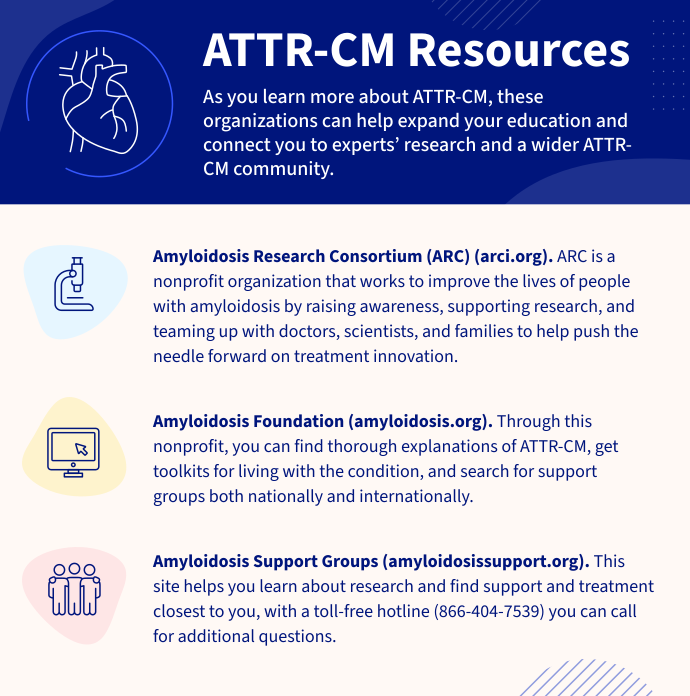
I would also advise people to get online and join Amyloidosis Support Groups.
I’ve always been a positive person, but before, I would downplay and slough off advice regarding health-related action steps. Lynn would say, “You know, you really do need to go see a pulmonologist,” and I'd say, “I do not.” My daughter would tell me about sleep apnea, and I would say, “it's not that bad.”
But the thing that's changed in me the most since being diagnosed with ATTR-CM is that I’ve learned to be more health-conscious.
I wish I didn't have ATTR-CM, but I can’t complain.